

Nobody told me these were symptoms.

Updated: May 23
How I went from "I probably don't need HRT" to patching up and figuring it out — at 51.
April–May 2026
Let me start by telling you about my best friend. About a year ago, she started HRT, and something shifted for her. She became more herself — more grounded, more empowered, fully in her Queen Era. Now, a lot of things changed in her life around that same time, so who's to say what was the HRT and what was circumstance? But I watched her, and I filed it away.
There was also my aunt — she's 71 this year, and like me, she's never been pregnant. She started HRT a couple of years ago (she uses the estrogen pellet) and her review was concise and memorable: it made her "a lot less bitchy." I appreciated the honesty. I also thought, well, that could be useful. I consider myself a fairly non-bitchy person most of the time, but I wasn't going to turn down the option.
The tricky thing is I didn't have a lot of female family reference points for what menopause actually looks like. My mom had a hysterectomy in her 40s — medical menopause — so her experience was a different road entirely. My older sister had children, which means her hormonal history looks different from mine. I was largely figuring this out without a map.
I was still pretty sure HRT wasn't for me, though. Here's my logic: I've never been pregnant, never had children, and my periods were always mild compared to most women I know. I didn't have what I thought of as "menopause symptoms" — no dramatic mood swings, no hot flashes, nothing that looked like the montage from a pharmaceutical commercial. And honestly? The black box warning slapped on estrogen back in the 90s — the one that sent everyone running because it supposedly caused breast cancer — that scared a lot of women off HRT for decades. Including, subconsciously, me.
So I figured I'd wait. Wait for the hot flashes. Wait for the symptoms. That's what you do, right?
Here's the thing nobody tells you: you might already have symptoms. You just don't know they're symptoms.
A couple of years ago, my annual physical came back with elevated LDL cholesterol.
I was confused. I'm not eating sticks of butter or pounds of shrimp. I'm not living on fast food. Where is this coming from? Around the same time, I started waking up at 3am. Every night.
For no discernible reason. If you've been anywhere near a menopause forum, you know about the 3am Club — it's a whole thing. And then there was the achiness. I'd wake up feeling like I'd spent the night doing grueling yard work. I hadn't. I'd driven to work, worked my 8–10 hour shift, driven home, eaten dinner, gone to bed. Rinse and repeat. No logical reason to feel like that.
I'll also be transparent about something: in November 2024, my therapist suggested I try an antidepressant because I had become genuinely, relentlessly irritable. Not sad — just done with everyone. My commute, my coworkers, people at home, strangers who had the audacity to exist near me. My gynecologist prescribed Zoloft (an antidepressant), and it helped. But I've since come to understand that what I was experiencing may have had a hormonal component all along. That's a thread I'm still pulling on.
And here’s something I’ve only connected recently, looking back: I was around 41 when I developed what seemed like allergies completely out of nowhere. An hour every morning of congestion and nose-blowing. Stuffed up all day, every day, for years. I’d never had allergies before in my life — no seasonal issues, nothing. I just assumed I’d developed them randomly, the way you assume a lot of things that happen in your 40s are just… random. Around the same time, I started getting migraines. Also new. Also unexplained. Also just accepted as my new normal.
I was 41. Perimenopause can begin in your late 30s or early 40s. I didn’t know that then. Most women don’t. We just quietly adapt to the new weird thing our body is doing and move on, because nobody connects those dots for us.
These things didn't seem connected. But they are. I found out about perimenopause — the period of time before actual menopause when your hormones start to shift — largely through the work of Dr. Mary Claire Haver, a board-certified OB/GYN who has basically dedicated her career to researching what happens to women's bodies during this phase of life and actually telling us about it. The elevated cholesterol, the couch rot, the disrupted sleep, the unexplained achiness, the "meno-belly" (yes, that's a real thing, linked to elevated cortisol) — all of it can be perimenopause. It just doesn't look like what we've been told menopause looks like.
I will also confess that I made a little pilgrimage. I was in Galveston visiting family and — because apparently this is who I am now — I asked my mom if she'd join me on a side quest to go find The 'Pause Wellness clinic, which Dr. Haver founded. We did. We walked in, and the doctor working that day was genuinely lovely. When I admitted I was fan-girling a little, she said she'd love to give me a tour — but she had a patient. She suggested I might want to get a photo in front of the door.
I absolutely did. Mom was a good sport about the whole thing.
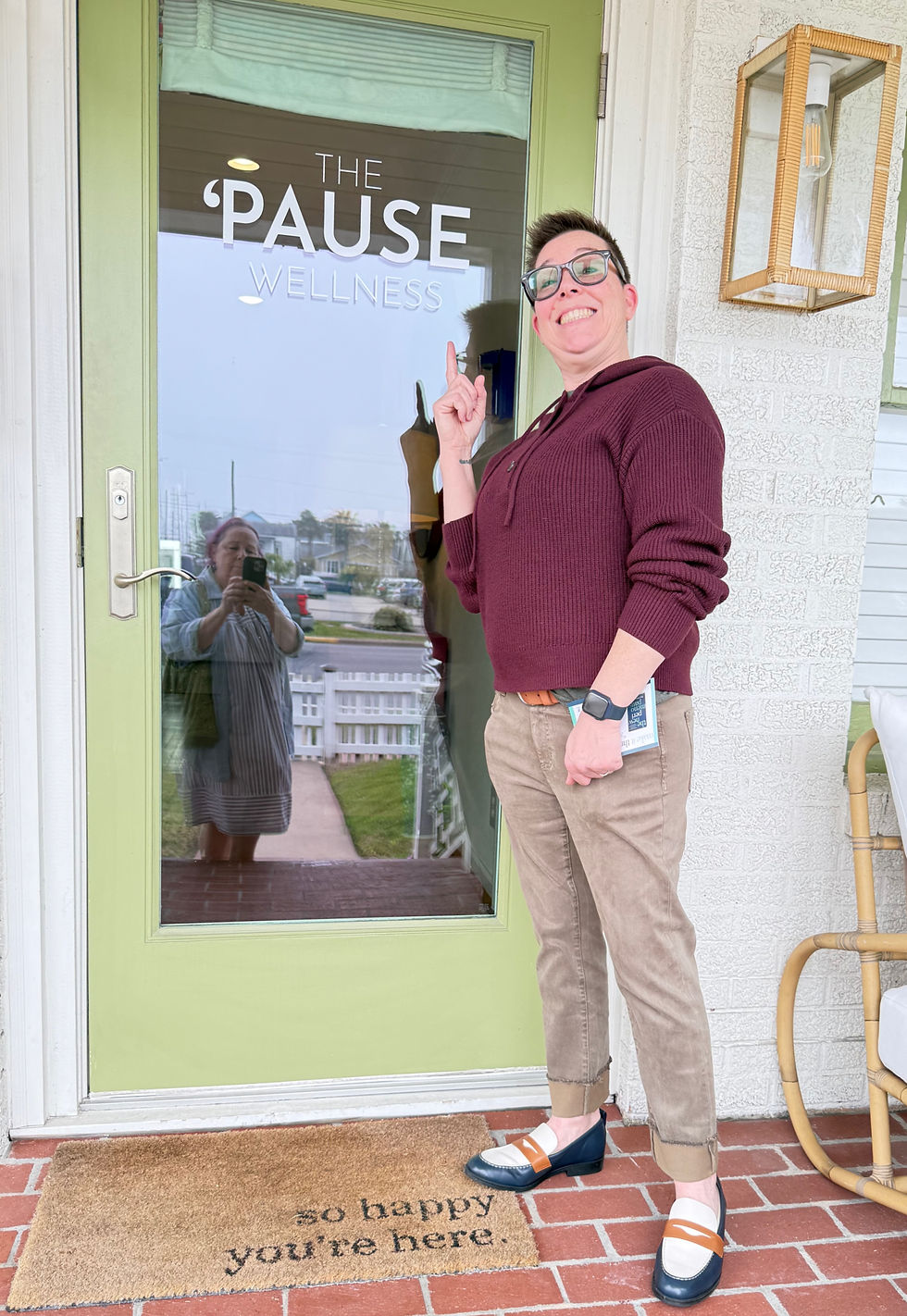
Back in December of last year, I went for my annual Well Woman exam and asked my OB/GYN when it would make sense to look into HRT. She told me: "when you start to have symptoms."
I nodded and went home. I still didn't connect the dots.
Then in January, I was at my mammogram and ultrasound, chatting with the ultrasound tech — a lovely woman a bit older than me. I was telling her about my life coaching work and my focus on midlife women: women who suddenly look up and realize their lives don't quite look the way they imagined. Women who wonder what happened to the optimistic, vivacious 25-year-old who ran half-marathons and felt like the world was wide open. (I turned 51 last week. I know this woman well.) We got talking about HRT, and she told me she's been on it — and that she feels like she's in her 20s again.
I have zero sex drive. I wake up achy. My LDL is elevated. I have dry eyes. I wake up at 3am. I have a meno-belly. I had been waiting for symptoms.
Ladies, these were the symptoms.
I went home and messaged my gynecologist through MyChart. I asked her to run labs and check my hormone levels. She did. The results came back "normal" — which is to say, they fell within the reference range for women my age. When she messaged to tell me everything looked fine, I wrote back and asked to start HRT anyway.
She asked me to come in for a consultation. I did. And she said something I will not forget:
"I don't really care what the numbers say. I want to treat you — the person — and your symptoms."
She prescribed exactly what I'd researched and asked for: transdermal estradiol and oral micronized progesterone. I started both on April 28th. So I am, as of this writing, a few weeks in.
Here's my completely honest, very early report: I've been sleeping through the night, which is genuinely amazing (though I'm also taking magnesium and practicing better sleep hygiene, so I'll let you draw your own conclusions). The morning achiness has been gone. I feel more motivated — not in a dramatic way, but in a quiet "I actually want to take care of myself" way. I haven't quite started exercising yet, but I want to. Progress.
On the less glamorous side: last week I was more irritable than usual. Not rage — just a low hum of "please stop being needy, everyone." Apparently this can happen as your body adjusts. The patch itself is a logistical puzzle — finding real estate on your body that isn't going to get rubbed by a waistband or peeled off by clothing is a genuine challenge. I tried medical tape on the advice of the internet, which gave me an itchy skin reaction, so now I have it covered with a large Band-Aid. Very chic. And I'm possibly growing more rogue chin hairs than before, which — honestly, I'm going to table that concern for now and revisit it at the 3-month mark.
This blog is part of my coaching work. I help midlife women navigate a season of life that nobody really prepares us for — not just the hormonal piece, but the identity piece, the "who am I now and what do I actually want" piece. The HRT journey is one thread in that larger story, and I'm going to document it honestly here: the wins, the weird side effects, the things I wish someone had told me sooner.
If you're in your 40s or 50s and something feels off — your sleep, your weight, your energy, your joints, your mood, your libido, your cholesterol — it might be worth asking some questions. Not just waiting for the hot flashes.
— More updates as this journey unfolds. We're just getting started.

RESOURCES
Want to learn more? Dr. Mary Claire Haver is a New York Times bestselling OB/GYN who has made it her mission to close the information gap around perimenopause and menopause.
Her books The New Menopause and The New Perimenopause are excellent starting points.
You can also explore her website The 'Pause Life (thepauselife.com) for resources, community, and education, or check out her podcast Dr. Mary Claire Haver unPAUSED .


Such great information, very insightful! I absolutely can relate to it all! Keep us updated on your progress with patch!